
Subtotal:
$ 0.00
Cell phone charging locker for sale Texas
A practical guide for venue managers, event organizers, universities, hospitals, hotels, retailers, and stadium operators evaluating secure phone charging lockers for a Texas property or event.
THE BEST CELL PHONE CHARGING LOCKERS IN TEXAS
Table of Contents
- Quick Answer
- What Is a Cell Phone Charging Locker?
- How Phone Charging Lockers Work
- Digital PIN vs. Keys vs. RFID
- How Many Lockers Does Your Venue Need?
- Best Charging Lockers for Texas Venues (by category)
- Texas City Context: Houston, Dallas–Fort Worth, Austin, San Antonio
- What Features to Look For
- Charging Cable Compatibility and Charging Speed
- Commercial Durability, Safety, and Maintenance
- Branding and Sponsorship Value
- Buy vs. Rent
- A Simple ROI Framework
- Comparison Table: Options Available to Texas Buyers
- Where Vischarge Fits
- 20-Point Buyer’s Checklist
- FAQs
- Final Verdict
1. Quick Answer
If you need a straight answer before reading further: for most mid-to-large Texas venues (conference centers, malls, hospitals, university unions, stadium concourses), a floor-standing, 8-to-16-compartment locker with a digital PIN lock and user-selected codes is the configuration that best balances security, throughput, and cost. Smaller venues (boutique retail, gyms, small offices) are usually better served by a 4–8 locker wall- or table-mounted unit. Very high-security or high-turnover environments (schools, hospitals, evidence-adjacent settings) sometimes justify the extra cost of RFID or badge-based access instead of, or alongside, PIN codes.
Several manufacturers and rental operators sell into the Texas market at this configuration, including regional players like Southwest Solutions Group (Austin, Dallas, Houston, San Antonio offices) for permanent installations, event-rental specialists like Charging Station Austin and Charging Station Dallas, and national online sellers like Vischarge, whose current product line includes a 12-locker unit with digital PIN locks. The right choice depends less on brand and more on your traffic volume, whether the deployment is permanent or event-based, and how much you value branding versus low sticker price. Sections 5 and 14 below walk through the sizing and comparison logic in detail.
2. What Is a Cell Phone Charging Locker?
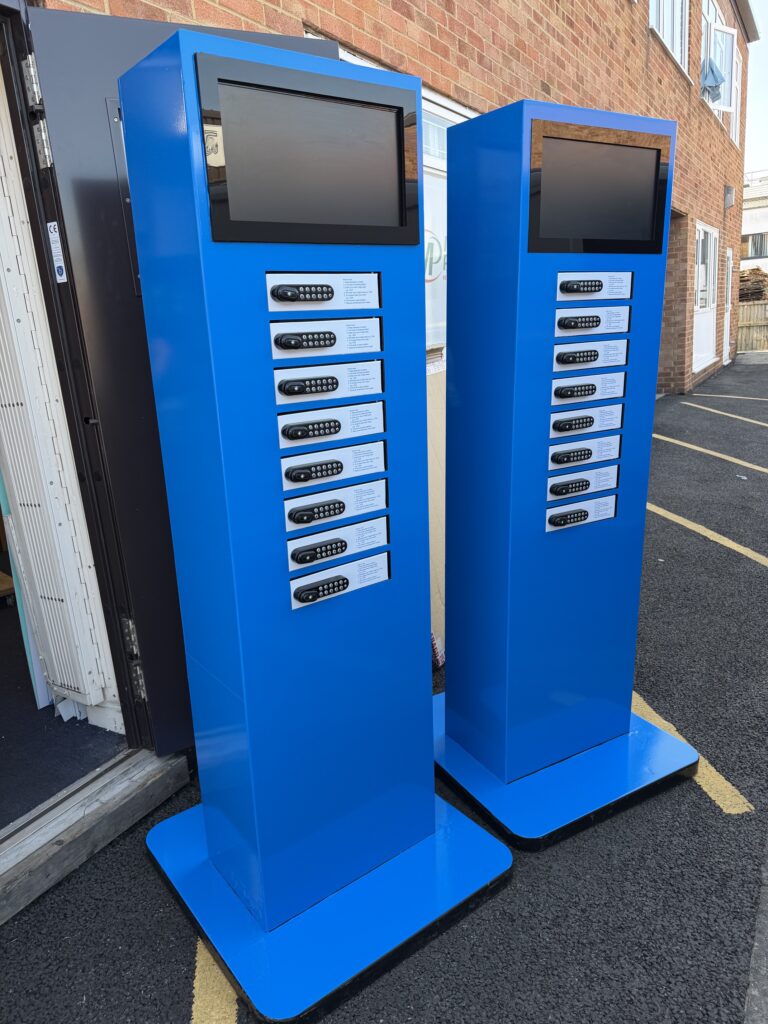
A cell phone charging locker is a bank of individually lockable compartments, each wired with a charging cable, that lets a visitor plug in a phone, close and lock the door, and walk away without holding onto — or worrying about — the device while it charges. This is the core difference from an open charging station (a table or kiosk with exposed cables and no compartment doors): a locker adds physical security on top of the charging function, so a user can leave the area entirely rather than standing next to their phone.
Lockers are typically sold in fixed configurations — commonly 4, 8, 12, 16, or 24 compartments — and are available as floor-standing cabinets, wall-mounted units, or tabletop units. They’re used across almost every category of public-facing venue: airports, malls, hospitals, universities, gyms, hotels, stadiums, and event venues of every kind.
3. How Phone Charging Lockers Work
The typical user journey is the same across nearly every commercial unit on the market:
- The visitor finds an available (unlit or “open”) compartment.
- They open the door, place the phone inside, and connect it to the built-in cable (or place it on a wireless charging pad, on units that support this).
- They close the door and set an access code on the keypad, or the unit assigns one, or they tap an RFID card/wristband depending on the lock type.
- The compartment locks and the phone charges.
- The visitor returns, re-enters their code or taps their credential, and retrieves the phone.
An administrator override (a master code, master key, or manager-level app access) is standard on commercial units, so staff can open a locker if a guest forgets their code or loses their credential — this is worth confirming with any vendor before purchase, since the procedure varies by manufacturer and matters a great deal on a live event day.
4. Digital PIN vs. Keys vs. RFID
| Lock type | How it works | Strongest for | Trade-offs |
|---|---|---|---|
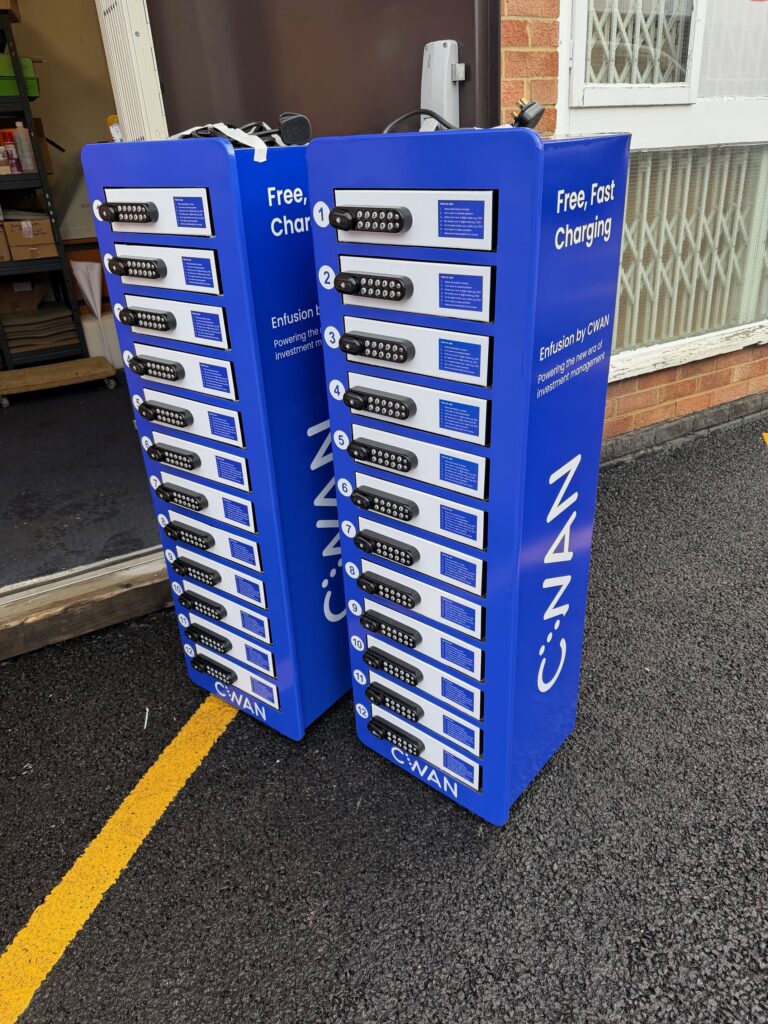
| Digital PIN keypad | User sets or is assigned a numeric code at the keypad | Events, malls, hospitals, general public use — no card/fob to issue or lose | Forgotten codes require staff override; keypad wear over years of high use |
| Physical key | Traditional lock and key, often numbered | Low-traffic, staff-managed environments (back-office storage, some gyms) | Keys are lost, duplicated, or not returned; slower for high-turnover public use |
| RFID / badge / wristband | Contactless tap using a card, fob, wristband, or phone-based credential | Universities, offices, hospitals, and any venue that already issues ID badges or wristbands | Requires issuing and managing physical credentials or a connected badge system; typically a higher-cost option than PIN-only |
For a venue that already has a badge or wristband system in place (a hospital ID system, a festival wristband program, a university ID card), tying the locker into that existing credential is often more convenient for staff than PIN codes. For a one-off public venue with no existing credential system — most malls, hotels, conference centers, and one-day events — a PIN keypad avoids the cost and logistics of issuing anything at all, which is why it remains the most common lock type across the Texas market as of 2026.
5. How Many Lockers Does Your Venue Need?
There’s no universal formula, but a reasonable starting framework:
- Estimate concurrent demand, not total foot traffic. What matters is how many people want to charge a phone at the same time, not how many people pass through your venue in a day. A stadium with 40,000 attendees doesn’t need 40,000 lockers — it needs enough to cover peak concurrent demand at a handful of well-placed locations.
- Rule of thumb for events: many rental operators size a single 8-locker unit for roughly 500–1,500 attendees at a conference or trade show, scaling up to multiple units, or a 12–24 locker unit, for larger conventions. Treat this as a starting estimate, not a guarantee — confirm sizing with your vendor against your specific attendee count and floor plan.
- 12 lockers is a genuinely useful mid-point for many permanent installations: malls, hospital lobbies, university unions, and mid-size hotels. It’s large enough to avoid constant “all compartments full” situations at moderate traffic, without the footprint or cost of a 24-locker unit.
- Go larger (16–24 lockers) or add a second unit when you have sustained high concurrent traffic: major stadium concourses, large convention halls, or airport terminals.
- Go smaller (4–8 lockers) for boutique retail, small gyms, coworking spaces, or single-department office use.
If you’re unsure, most vendors — including the ones in this guide — will size a deployment against your attendee count or footfall data for free before you commit to a purchase.

6. Best Charging Lockers for Texas Venues, by Category
Events, conferences, and trade shows
Event use is dominated by rental, not purchase, because the deployment is temporary and setup/teardown logistics matter more than long-term ownership. Texas-specific event rental operators — such as Charging Station Austin and Charging Station Dallas — deliver, set up, brand, and remove units for a single event, and offer both open tables and locking compartments. For a SXSW-scale activation or a multi-day trade show, branding (sponsor logos, event colors) is often the actual point of the unit, not just the charging function — see Section 11.
Universities and colleges
Campus deployments tend to be high-traffic and unsupervised for long stretches, which pushes toward durable, permanently installed units — often in student unions, libraries, and residence hall lobbies. RFID or campus-ID-linked access is worth considering here, since students already carry a campus ID card. Southwest Solutions Group, which has Texas offices in Austin, Dallas, Houston, and San Antonio, specifically markets keyed, PIN, and RFID cell phone locker configurations into education and secure-facility settings.
Hospitals and healthcare facilities
Visitor and patient-family charging in waiting rooms and lobbies is a genuine amenity need — people in hospitals are often there for hours with no ability to leave a phone unattended. Look for units with simple, low-friction PIN entry (visitors are frequently stressed and unfamiliar with the venue), an easy staff-override procedure, and — if the facility has infection-control policies — hard, wipeable surfaces rather than porous materials.
Hotels
Lobby and conference-floor placement is standard. Hotels hosting their own conferences or weddings often want the unit rebranded per event, which makes a system with quick, tool-free branding changes more valuable than one with a fixed printed wrap.
Retail and malls
The commercial case here is dwell time: a shopper who charges their phone in-store or in a mall common area stays longer. Malls also frequently monetize the space by selling branding to an advertiser or tenant rather than paying for the unit’s marketing value themselves.
Stadiums and arenas
High concurrent demand at a small number of well-trafficked concourse locations. Durability and lock reliability matter more here than almost anywhere else, given the volume of daily cycles during event season. Sponsorship branding is also usually a meaningful part of the commercial case — see Section 11.
7. Texas City Context
Houston has the state’s heaviest concentration of large-venue demand in one place: a major convention center (George R. Brown), two international airports, the Texas Medical Center (one of the largest medical complexes in the world), and a dense cluster of stadiums and arenas. Charging lockers here skew toward high-traffic, high-durability permanent installs — medical-center lobbies and convention/trade-show floors in particular.
Dallas–Fort Worth combines heavy corporate event and convention traffic (Kay Bailey Hutchison Convention Center, numerous corporate campuses) with major sports venues and one of the busiest airports in the country. Corporate branding and sponsor-driven deployments are especially common here, given the concentration of Fortune 500 regional offices.
Austin is shaped by its festival and tech-conference calendar (SXSW being the standout example) — short, intense bursts of extremely high concurrent demand, which is why event rental (rather than purchase) dominates the Austin market for temporary activations, alongside permanent installs at the university and in the city’s dense conference-hotel corridor.
San Antonio leans toward tourism and hospitality: convention center traffic (Henry B. González Convention Center), a large hotel base, and major visitor attractions, where guest-facing charging lockers function primarily as a hospitality amenity rather than a sponsorship platform.
Smaller and mid-size markets — Corpus Christi, Lubbock, Amarillo, Waco, Galveston, Sugar Land, The Woodlands, Round Rock — see charging lockers mostly through regional convention centers, hospitals, university campuses, and local event venues, and generally source from the same national rental/purchase vendors serving the major metros, with shipping and installation logistics being the main practical difference versus a Houston or Dallas deployment.
8. What Features to Look For
A practical checklist for evaluating any unit, regardless of vendor:
- Lock type (PIN, key, RFID) and whether it matches how you’ll actually manage access
- Number of compartments and physical footprint (floor-standing vs. wall vs. tabletop)
- Cable types included per compartment (see Section 9)
- Whether wireless charging pads are included or optional
- What happens on a forgotten PIN or lost credential — the administrator override process
- Branding/wrap process — is it a printed decal, an interchangeable panel, or a fixed factory finish?
- Warranty length and what it actually covers (parts only, or parts and labor/service visits)
- Whether a service contract or maintenance plan is included, and what response time it promises
- Shipping/delivery timeline, and whether installation is included or a separate line item
- Electrical requirements — most units run on standard 110V outlets, but confirm before committing to a specific placement
9. Charging Cable Compatibility and Charging Speed
Commercial units on the market generally cover the three cable types needed for full device compatibility:
- USB-C — now standard on the large majority of current Android phones and, since 2023, current-generation iPhones
- Lightning — still relevant for the large installed base of older iPhones still in daily use
- Micro-USB — increasingly rare on current phones but still present on some budget Android devices, older tablets, and accessories
Wireless (Qi) charging pads are offered as an added or optional feature on some units. It’s worth asking any vendor directly about charging output — wattage or amperage figures are often quoted by manufacturers but vary in real-world testing depending on the phone being charged, the cable condition, and how many compartments are drawing power simultaneously. Treat any single headline wattage figure as a starting point for comparison rather than a guarantee of charging time for a specific device.
10. Commercial Durability, Safety, and Maintenance
“Commercial-grade” isn’t a regulated term, so it’s worth asking any vendor specifically about:
- Gauge of steel or material used in the cabinet body and doors — a heavier gauge resists dents and forced-entry attempts better than lightweight consumer-grade metal
- Cable replacement — cables are the highest-wear component on any charging locker; ask how a failed cable is replaced (a technician visit, a customer-replaceable part, a full compartment swap) and at what cost
- Lock mechanism failure — what’s the process if a keypad or RFID reader fails, and does the warranty or service contract cover it
- Ventilation — charging electronics generate heat; enclosed compartments should have some ventilation design rather than being fully sealed
- Ongoing maintenance — ask what routine maintenance (if any) the manufacturer recommends and whether it’s covered under warranty or billed separately
Avoid taking “certified” or “commercial-grade” claims at face value without asking which specific certification (UL, ETL, or another recognized body) applies, and to which component of the unit.
11. Branding and Sponsorship Value
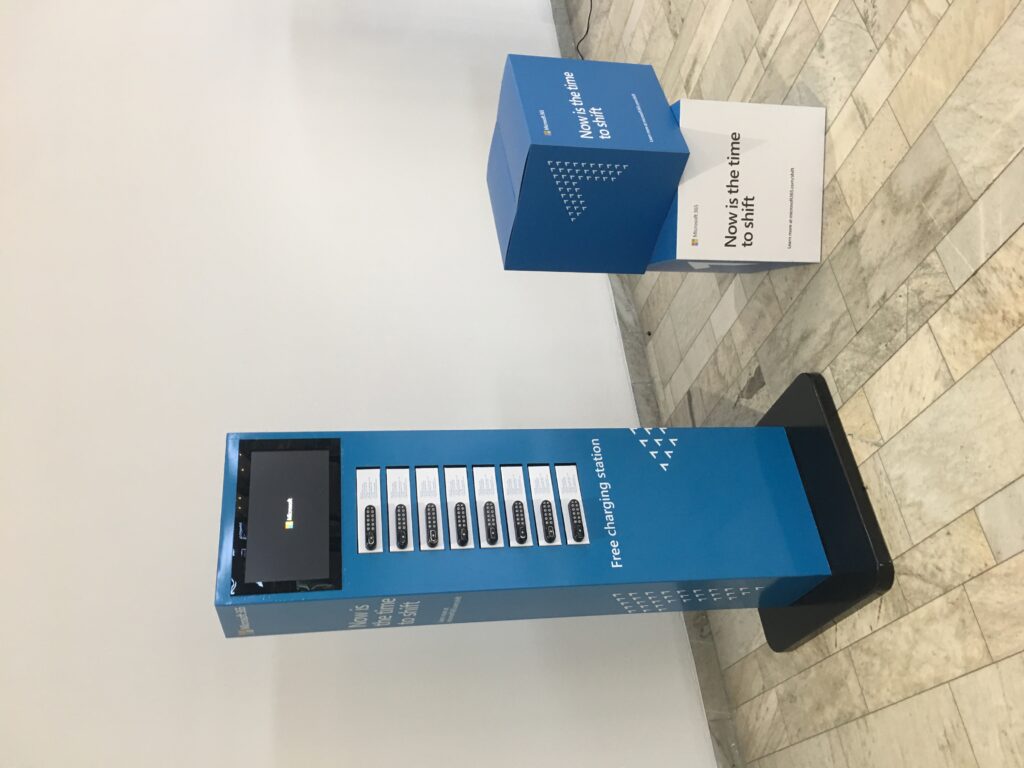
For events, malls, hotels, and stadiums in particular, a charging locker is often bought as much for its branding surface as for the charging function itself. Common approaches:
- Venue branding — a hotel or mall wraps the unit in house colors as a permanent amenity
- Event branding — a conference or festival wraps the unit for the duration of the event, often reusing the same physical unit for multiple events with a new wrap each time
- Sponsor-funded branding — an event sells the charging station as a sponsorship line item, with the sponsor’s logo on the unit in exchange for covering some or all of the rental/purchase cost
- QR-code integration — some deployments add a QR code linking to a website, social page, or promotion, turning idle charging time into a lightweight engagement touchpoint
How easily a unit can be rebranded — a swappable printed panel versus a permanent factory finish — is worth asking about directly if you expect to reuse the same physical unit across multiple events or seasons.
12. Buy vs. Rent
Rent when:
- The deployment is for a single event or a short series of events
- You want a different brand wrap for each use and don’t want to own the hardware
- You’re testing whether charging lockers are worth it for your venue before committing capital
Buy when:
- You have a permanent location with sustained daily traffic (a lobby, a concourse, a student union)
- You want full control over branding and placement without recurring rental fees
- The unit will be in continuous use long enough that ownership is cheaper than repeated rental over its useful life
Some Texas event rental operators (see Section 6) publish monthly leasing rates for temporary or semi-permanent placements, which is a useful middle option between a single-event rental and an outright purchase — worth asking about if you’re not ready to commit to buying.
13. A Simple ROI Framework
There is no universal dollar figure for what a charging locker “returns,” and any vendor who quotes you a guaranteed revenue number should be treated with skepticism. What you can do is build a hypothetical model specific to your venue:
Example (illustrative only — substitute your own numbers):
- If your venue sees 2,000 visitors on a typical day, and even a conservative 3% use the charging locker, that’s 60 uses per day.
- If dwell time for those 60 visitors increases by even 10–15 minutes because they’re waiting nearby rather than leaving to find an outlet, that’s incremental time spent on-site — valuable in a retail or hospitality context specifically because longer dwell time is correlated with higher spend, though the exact relationship varies by venue type and isn’t something a charging locker alone can guarantee.
- If the unit is sponsor-branded and the sponsorship fee covers some or all of the unit’s cost, the “return” is realized as sponsorship revenue rather than incremental visitor spend.
Use this only as a structure for building your own estimate against your own attendance and spend data — not as a projection of what any specific unit will generate for you.
14. Comparison Table: Options Available to Texas Buyers
| Provider | Model type | Lockers | Lock type | Branding | Warranty/Service | Best for |
|---|---|---|---|---|---|---|
| Southwest Solutions Group | Purchase, permanent install | Configurable | Key, PIN, or RFID | Not publicly disclosed | Not publicly disclosed | Schools, offices, healthcare, secure facilities; has physical Texas offices (Austin, Dallas, Houston, San Antonio) |
| Charging Station Austin / Charging Station Dallas | Event rental | Tables and lockers, configurable | Not publicly disclosed | Custom branding available for rental | N/A (rental service) | Single-event and multi-day conference/festival deployments in Austin, Dallas, Fort Worth, San Antonio |
| Priceless Events (Central Texas) | Event rental | 8-bay unit (MIA S PRO model) | PIN code | Digital signage screen included | N/A (rental service) | Conferences, sporting events, festivals; monthly leasing from a published starting rate |
| Vischarge (vischarge.us) | Purchase | 12-locker configuration (also 4, 8, 16, 24 options per site) | Digital PIN; key and RFID also listed as options on some models | Custom branding, per vischarge.us | Vendor states a 10-year service contract on current promotions — confirm current terms directly with Vischarge | Businesses and venues wanting a purchased, brandable unit shipped nationally; confirm current pricing and promotional terms directly, as the vendor’s site runs frequently changing limited-time offers |
Where a specification isn’t independently verifiable from public sources, this table says so rather than guessing. Pricing for most of these providers is quote-based and not published, so get a current quote before comparing on cost.
15. Where Vischarge Fits
Vischarge (vischarge.us) sells directly to businesses nationally, including Texas, and its current core product is a 12-locker configuration with digital PIN locks, with the site also listing key and RFID opening options on some models and support for Lightning, USB-C, and Micro-USB cables. That’s a genuinely competitive spec sheet for the mid-size permanent-installation use case described in Section 5 — the 12-locker size sits right at the sweet spot for malls, hospital lobbies, university unions, and mid-size hotels discussed above.
A few practical notes if you’re evaluating Vischarge specifically:
- The company’s site advertises a range of promotional offers — free branding, free shipping, and an extended service contract — that are described as limited-time. Treat these as current promotions to confirm directly with Vischarge at the time you request a quote, rather than permanent product terms, since promotional offers on their site change and in some cases carry inconsistent descriptions of length and coverage across different pages of the same site.
- Vischarge is a national online seller without a disclosed Texas-based physical office, unlike Southwest Solutions Group, which has staffed Texas locations. If in-person consultation, local installation support, or a Texas-based point of contact matters to your purchasing process, that’s worth asking about directly.
- As with any vendor, ask for the current specification sheet, warranty document, and reference customers in writing before purchasing — this is good practice with any charging-locker vendor, not specific to Vischarge.
None of this means Vischarge is a poor option — a 12-locker PIN-lock configuration is a reasonable, competitively specced product for a lot of Texas venues. It means the standard due-diligence steps (get specs and terms in writing, confirm current promotional offers directly, ask about install/service logistics for your specific location) apply here the same as with any vendor.
16. 20-Point Buyer’s Checklist
- What’s your realistic concurrent-demand estimate, not total foot traffic?
- Floor-standing, wall-mounted, or tabletop — which fits your space?
- PIN, key, or RFID — does your venue already have a credential system to tie into?
- Does the unit support USB-C, Lightning, and Micro-USB?
- Is wireless charging included, optional, or unavailable?
- What’s the administrator override procedure for a forgotten code?
- What’s the branding process, and how easily can it be changed later?
- What warranty length and coverage applies, in writing?
- Is a service contract included, and what response time does it promise?
- What’s the delivery timeline to your specific Texas location?
- Is installation included, or a separate cost?
- What electrical requirements does the unit have?
- Is the vendor quoting a permanent spec or a time-limited promotion?
- Does the vendor have a physical presence or support team in Texas?
- What happens if a charging cable fails — replacement process and cost?
- What happens if the lock mechanism fails?
- Is the unit rated for your expected daily-use volume?
- Buy or rent — which matches your deployment timeline?
- Can you get references or examples of similar deployments?
- Does the total quote include tax, shipping, and installation, or are these separate?
17. FAQs Cell phone charging locker
What is a cell phone charging locker? A bank of individually lockable compartments, each with a charging cable, that lets someone charge a phone securely without staying next to it.
How much does a cell phone charging locker cost? Pricing is largely quote-based across the vendors researched for this guide and not consistently published. Expect cost to vary significantly by locker count, lock type, and whether you’re buying or renting — get a specific quote for your configuration.
Are phone charging lockers secure? They add meaningful physical security compared to an open charging table, but no locker system should be described as theft-proof. Ask about the specific lock mechanism and any admin-override safeguards.
How do PIN charging lockers work? The user sets or is assigned a numeric code on the compartment’s keypad when they lock it, then re-enters the same code to retrieve their device.
How many phones can a 12-locker station charge at once? Up to 12 — one per compartment, assuming each compartment is occupied and the unit’s power supply supports full concurrent load. Confirm concurrent-load capacity with the specific manufacturer.
Can charging lockers charge iPhones and Samsung phones? Most current commercial units include Lightning, USB-C, and Micro-USB cables, covering the current iPhone and Android lineups; confirm the specific cable set with the vendor.
Are charging lockers suitable for universities? Yes — campus student unions, libraries, and residence halls are common deployment points, and RFID/campus-ID-linked access is often a good fit given students already carry ID credentials.
Are charging lockers suitable for hospitals? Yes, particularly in visitor and family waiting areas; look for simple PIN entry and wipeable surfaces.
Can charging lockers be branded? Yes — most vendors in this guide offer some form of custom branding, from printed wraps to swappable panels; ask specifically how the branding is applied and how easily it can be changed for reuse across multiple events.
Should I buy or rent a charging locker? Rent for single events or short-term deployments; buy for permanent, high-traffic locations. See Section 12.
What happens if a user forgets their PIN? Commercial units include an administrator override — a master code or manager-level access — but the exact procedure varies by manufacturer; confirm it before deployment.
What warranty should I expect? Warranty terms vary significantly by vendor and aren’t standardized across the industry; get the specific warranty document in writing rather than relying on marketing copy.
How long do charging lockers last? This depends heavily on build quality, daily-use volume, and maintenance; ask any vendor directly about expected service life for their specific unit rather than assuming a universal figure.
Do charging lockers require special electrical installation? Most run on standard 110V outlets, but confirm this for your specific unit and intended placement before committing to a location.
Where should I place a charging locker? High-visibility, high-dwell-time areas — lobbies, concourses, waiting areas — with access to a standard power outlet and enough clearance for the specific unit’s footprint.
18. Additiona Free Cell phone charging locker with with your order today!
For most Texas venues weighing a permanent installation, a 12-locker digital-PIN unit hits a genuinely useful middle ground between capacity and cost, which is why it’s a common configuration across multiple vendors in this market, including Vischarge. For single events, Texas-based rental operators like Charging Station Austin, Charging Station Dallas, and Priceless Events offer lower-commitment options with local delivery and setup. For institutions that already manage physical access via badges or ID cards — universities, hospitals, some office campuses — an RFID-capable system from a vendor like Southwest Solutions Group, which maintains physical Texas offices, may integrate more smoothly than a PIN-only unit.
Whichever vendor you evaluate, treat the checklist in Section 16 as your baseline due-diligence process: get specs, warranty terms, and any promotional offers in writing before purchasing, and confirm concurrent-demand sizing against your own venue’s traffic rather than a generic industry rule of thumb.
Email us now for the free additional unit offer!