
Subtotal:
$ 0.00
A commercial phone charging lockers buyer’s guide for venues, events and businesses evaluating secure phone charging station infrastructure in Doha and across Qatar.
Phone charging lockers Qatar | phone charging station Doha, 12 locker phone charging station, digital PIN charging locker, secure phone charging locker Qatar
Table of Contents
Best Phone Charging Lockers in Doha, Qatar: The Complete Phone Charging Station Buyer’s Guide 2
Introduction 2
- What Is a Phone Charging Locker? 3
- Phone Charging Locker vs Phone Charging Station 3
- Why Secure Charging Matters in Doha and Qatar 4
- How Digital PIN Phone Charging Lockers Work 5
- What Makes a Good Commercial Phone Charging Locker? A Buyer’s Checklist 6
- How Many Lockers Do You Need? 6
- Why a 12-Locker Phone Charging Station Can Be a Practical Sweet Spot 7
- The Vischarge 12-Locker Phone Charging Station 8
- Digital PIN Locks: What Buyers Should Know 9
- PIN vs RFID vs Key Locks 9
- Charging Cables and Device Compatibility 10
- Understanding “Fast Charging” Claims 11
- Charging Lockers by Venue Type in Doha and Qatar 11
- Custom Branding as a Commercial Asset 13
- Logistics, Shipping and Local Qatar Support 13
- Service Contracts vs Warranty — They Are Not the Same Thing 14
- Total Cost of Ownership 14
- Return on Investment: A Responsible Framework 15
- Safety, Electrical Considerations and Placement 15
- Wall-Mounted vs Tabletop vs Freestanding Floor Units 16
- Choosing a Phone Charging Locker Supplier in Qatar: The Procurement Checklist 17
- Comparing the Market: Where Vischarge Sits 17
- A Buyer Scorecard for Comparing Charging Lockers 18
- Common Mistakes When Buying Charging Lockers 18
- Real-World Buyer Scenarios (Hypothetical Examples) 19
- Final Buying Guide: A Decision Framework 19
Frequently Asked Questions 20
Offer Verification Checklist 23
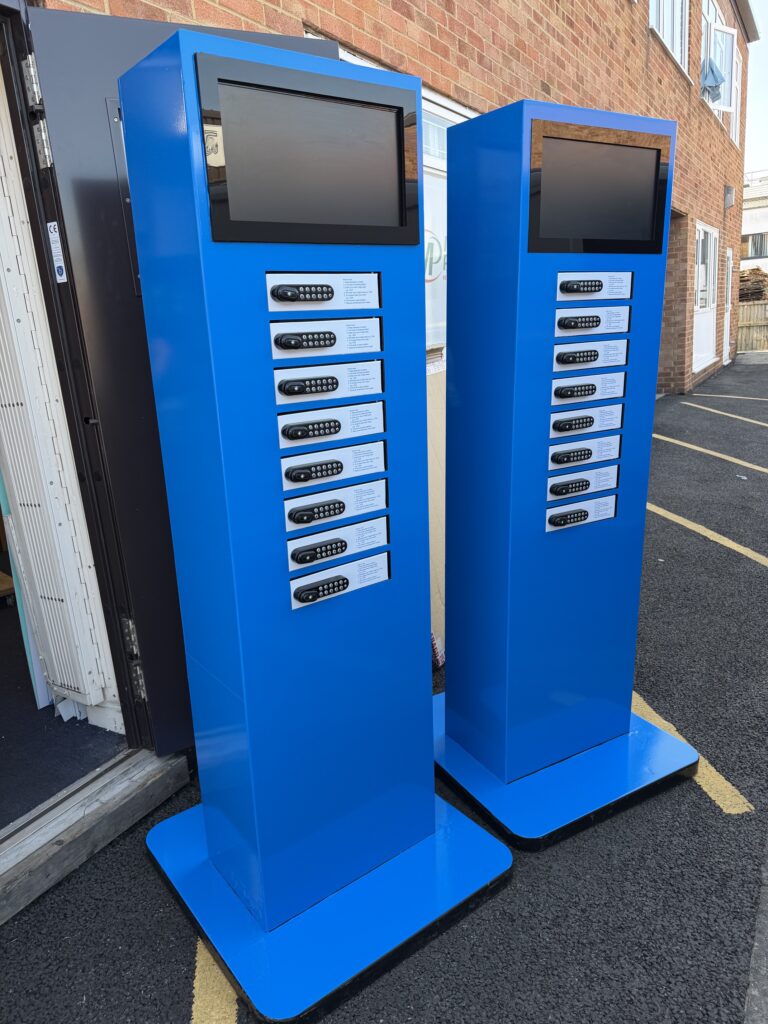
Introduction Phone Charging Lockers Qatar
A venue can get the Wi-Fi right, the seating right and the service right, and still lose a visitor’s goodwill the moment their phone hits 5%. In Doha — a city built around events, retail and hospitality on a scale few markets can match — a flat battery is not a minor inconvenience. It is the moment a visitor stops scanning e-tickets, stops paying by phone, stops navigating the mall, and starts looking for the exit.
Qatar is one of the most connected markets in the Gulf. Mobile devices are the default tool for payments, navigation, event access and everyday communication, and that dependence has only grown as Doha has taken on a steady calendar of conferences, exhibitions, sporting fixtures and tourism-driven footfall. Businesses that host visitors — malls, hotels, exhibition halls, offices, universities, hospitals — increasingly treat charging as infrastructure, not decoration.
An open charging point solves half the problem. It gets a phone powered up, but it does nothing about the fact that most people will not walk away and leave an unattended smartphone plugged into a public cable. A lockable phone charging locker solves the other half: it charges the device and stores it securely behind a PIN, an RFID card or a key, so the owner can shop, eat, attend a session or clear security without holding their phone the entire time.
This guide is written for the person actually doing the buying — a procurement manager, venue operator, event organiser or facilities lead in Doha or elsewhere in Qatar — who needs to understand what a charging locker actually is, how many lockers a venue realistically needs, what separates a well-built commercial unit from a budget import, and what questions to put to any supplier before signing a purchase order. It also looks in detail at the Vischarge 12-Locker Phone Charging Station, a digital-PIN locker unit Vischarge sells into the Qatar and wider GCC market, and explains where it fits and where it doesn’t.
Nothing here is written to talk you into a single “right answer.” A 12-locker unit is not automatically correct for every venue, and this guide says so. Where a claim about pricing, delivery timing or a current promotional offer can change at short notice, that is flagged clearly rather than stated as fixed fact — you should always confirm current commercial terms directly with a supplier before ordering.
1. What Is a Phone Charging Locker?
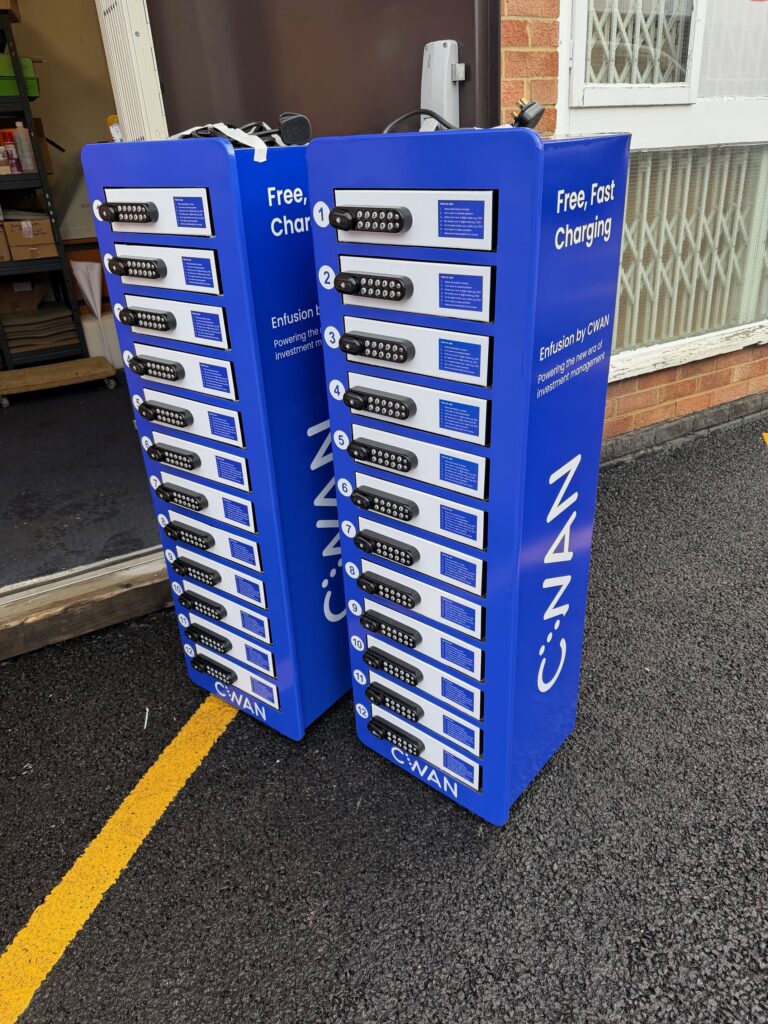
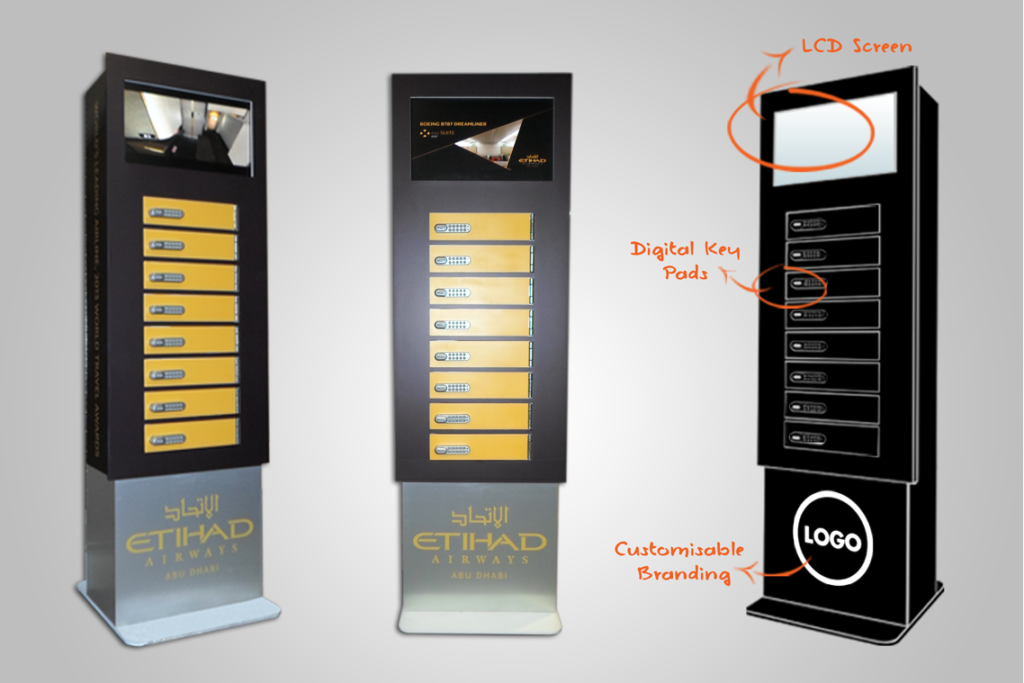
A phone charging locker is a freestanding or wall-mounted cabinet divided into individual, lockable compartments. Each compartment contains one or more charging cables (commonly USB-C, Lightning and Micro USB, sometimes alongside a wireless charging pad), so a visitor places their phone inside, connects it, closes the door, and locks it using a PIN code, an RFID card or key, or in some models an intelligent sensor.
The distinguishing feature is that the charging and the security happen in the same place. The phone charges while it is out of sight and inaccessible to anyone else, and the owner is free to move around the venue without carrying it or watching over it.
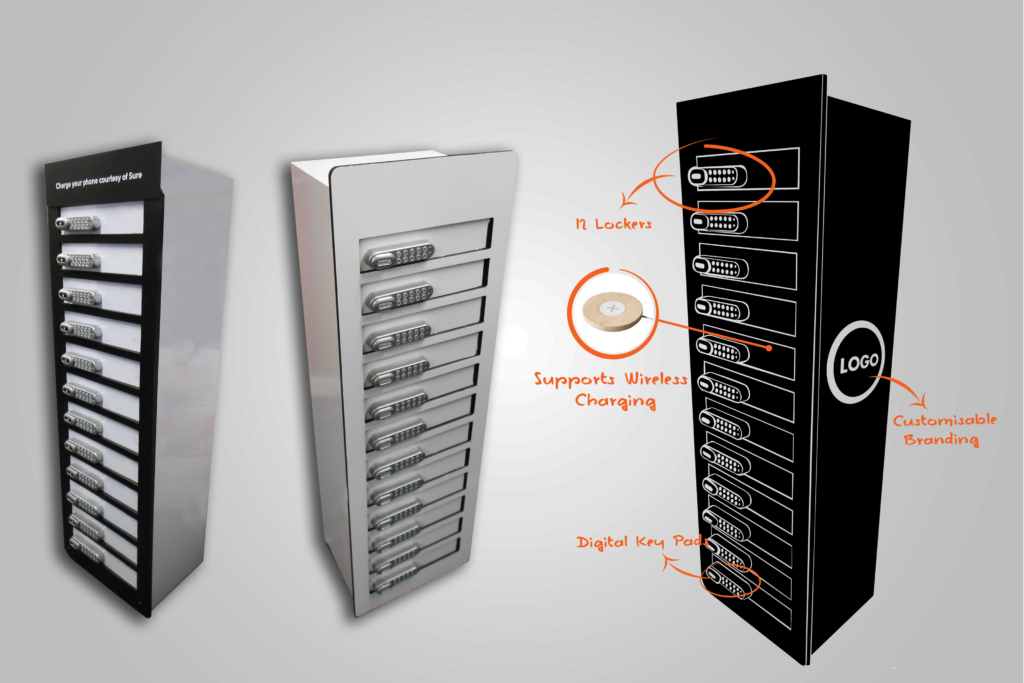
A typical commercial unit is built around a few core components:
None of this requires a network connection or an app in the simplest units — a locker with PIN or key access can run entirely standalone. More advanced units add an LCD screen, usage analytics, or a connection to a digital signage/advertising network, which is a genuinely different (and more expensive) product tier and should be evaluated separately from a basic PIN-lock unit.
For a non-technical buyer, the plain-English summary is: it’s a secure phone-sized locker that happens to charge whatever you put inside it.
2. Phone Charging Locker vs Phone Charging Station
“Charging station” is often used loosely to describe two genuinely different products, and mixing them up is one of the most common procurement mistakes.
| Factor | Locker-based station (secure) | Open/non-locker station |
| Security | Individual PIN/RFID/key per user; device out of sight | None — cable and phone sit in the open |
| Theft/tampering risk | Low, device enclosed | Higher, especially unsupervised areas |
| Simultaneous users | Fixed by locker count (e.g. 12) | Often more charging points per footprint, but shared open surface |
| Customer confidence | High — visitor can walk away | Visitor typically has to stay nearby |
| Footprint | Larger cabinet, needs floor or wall space | Can be a slim table, ledge or wall unit |
| Branding surface | Large — full cabinet wrap | Smaller — usually a header panel |
| Best suited to | Malls, events, hospitals, offices, universities — anywhere a visitor wants to leave the device | Cafés, waiting rooms, gyms — anywhere the visitor stays seated nearby |
| Relative cost | Higher (more hardware, more electronics, more locks) | Lower |
Neither option is universally “better.” An open charging ledge in a café where customers are already seated at a table gives up nothing by being unlocked — the phone is in view the whole time. The same open design in a shopping mall food court, where a visitor might walk off to browse a nearby store, creates a real risk that a phone gets picked up by someone else. The right choice depends on whether your visitors are expected to stay near the device or leave it and come back — and Doha’s highest-footfall venues (malls, exhibition halls, stadiums, hotel lobbies) are overwhelmingly the second kind.
3. Why Secure Charging Matters in Doha and Qatar
Qatar’s commercial landscape has a specific shape that makes charging infrastructure more than a nice-to-have:
The practical tension in all of these settings is the same: people want to charge their phone, but they don’t want to sit next to a cable for forty minutes to protect it, and they don’t want to hand a $1,000 device to a stranger at a “leave it with us” counter. A locker with a PIN the visitor sets themselves resolves that tension without needing staff supervision.
4. How Digital PIN Phone Charging Lockers Work
The user journey on a PIN-lock charging locker is deliberately simple, and this simplicity is a large part of why lockers work in unsupervised public spaces:
Two other access methods sit alongside PIN entry on most commercial units:
Administrator/master access is the feature procurement teams should always ask about directly. A commercial-grade unit should let venue staff open any compartment with a master code or master key, independent of what PIN the visitor set — because visitors will forget PINs, and a locker that can only be opened by the person who set it is a liability, not a convenience feature.
5. What Makes a Good Commercial Phone Charging Locker? A Buyer’s Checklist
Before comparing specific products, it helps to have a checklist that isn’t tied to any one supplier’s marketing copy. A commercial-grade unit should be judged against:
6. How Many Lockers Do You Need?
There’s no single formula that fits a hospital waiting room, a stadium concourse and a corporate reception desk, but the underlying logic is consistent: you’re sizing for peak simultaneous demand, not total daily visitors.
A venue expecting 2,000 visitors across a day does not need 2,000 lockers, because very few of those visitors want to charge at the exact same moment, and the average charge-and-collect cycle (roughly 20–45 minutes depending on device and cable) means each locker turns over repeatedly through the day. What matters is:
As a working reference point (not a guarantee), here’s how organisations typically think about scale:
The honest takeaway: use the checklist above to estimate your own peak concurrency, and treat any single number a supplier gives you as a starting point for discussion, not a rule.
7. Why a 12-Locker Phone Charging Station Can Be a Practical Sweet Spot
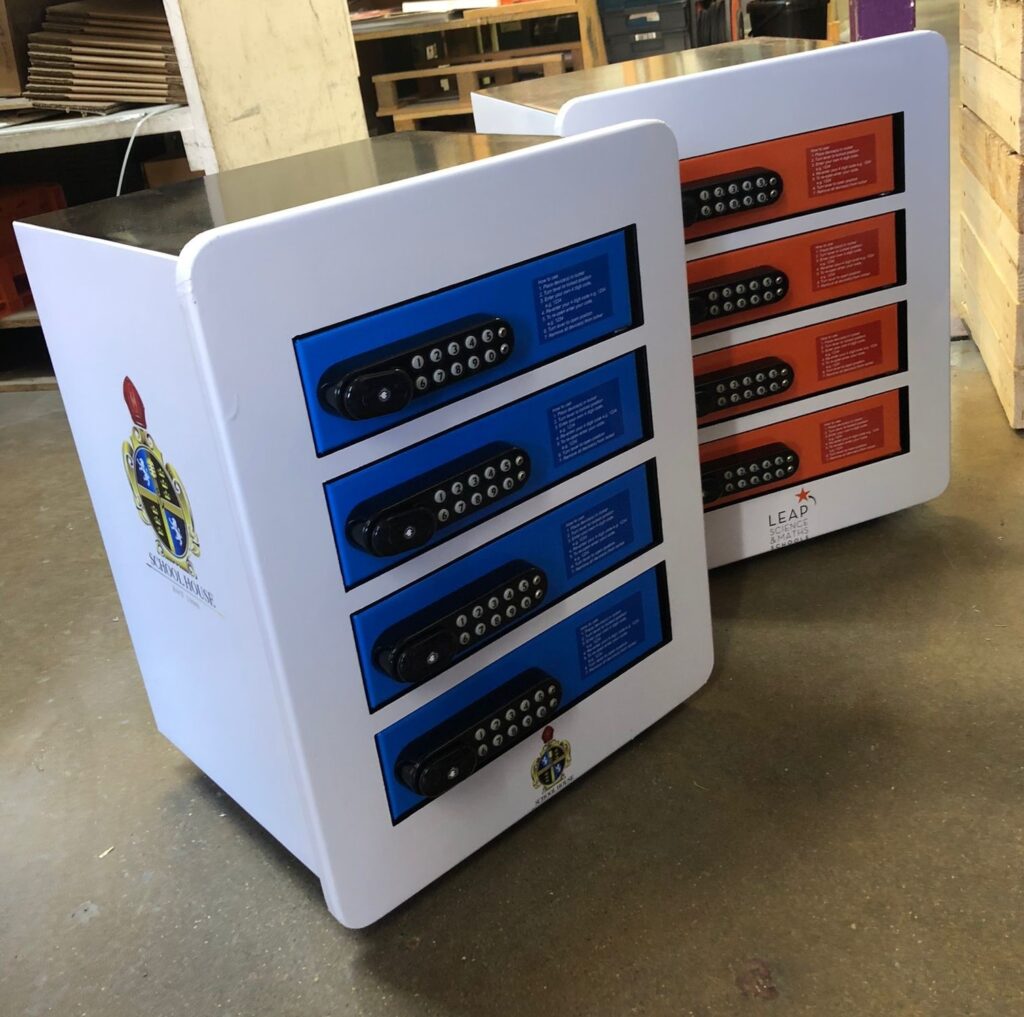
Between the smallest units (typically 4 lockers) and the largest (20+ lockers), a 12-locker configuration sits at a point that tends to work for a wide range of Doha venues for a few concrete reasons:
This doesn’t mean 12 is correct for every venue — a small café or a compact office reception is very likely over-specified with 12 lockers, and a major stadium concourse may need several units, not one. But for the mid-size, high-footfall venues that make up a large share of Doha’s malls, hotels, universities, and event spaces, it’s a size worth using as a starting comparison point.
8. The Vischarge 12-Locker Phone Charging Station
Vischarge is a supplier of commercial phone charging lockers and charging stations operating across the US, Europe, the UK and the GCC, including a Qatar presence (Doha). Its core product for the Qatar market is the 12-Locker Phone Charging Station — a digital-PIN-lock cabinet built for continuous public use.
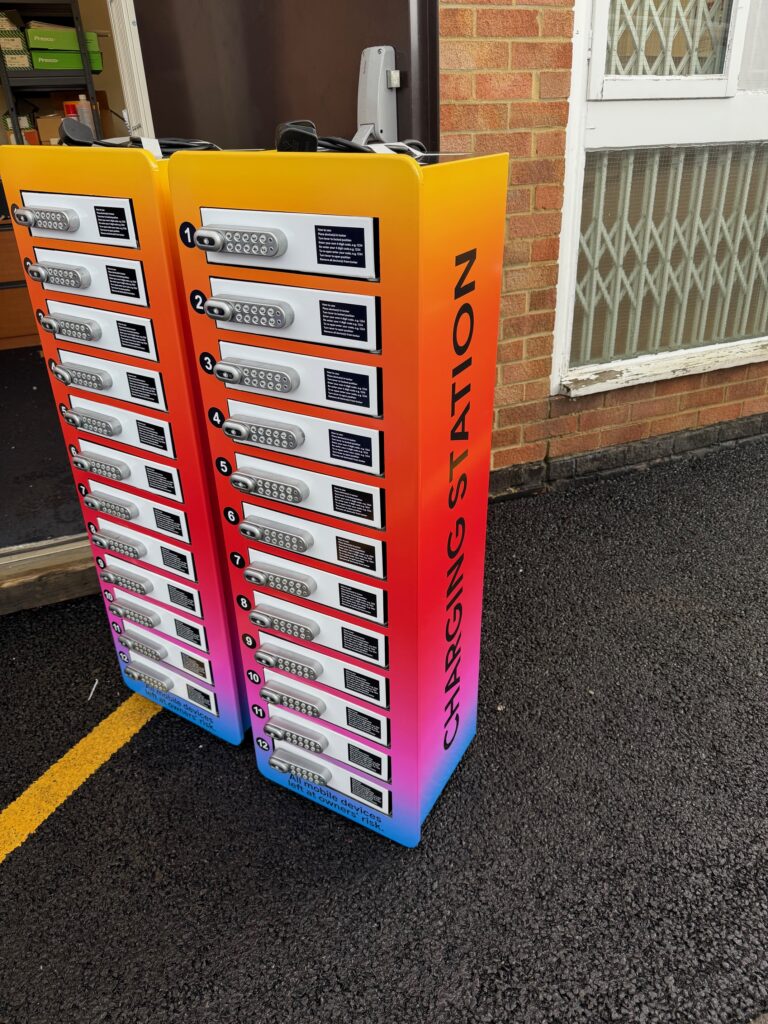
Based on Vischarge’s published product information, the 12-locker unit is specified as follows:
Vischarge markets this unit at malls, airports, universities, hospitals, hotels, exhibitions, government buildings, sports venues and retail destinations across Qatar and the wider GCC (UAE, Saudi Arabia, Bahrain, Kuwait), and lists a Doha office address (Banks Street, Doha, Blue Towers) as part of its regional presence.
On current commercial offers: at the time of writing, Vischarge’s public-facing pages reference a promotional offer describing a free additional charging locker and free custom branding with new orders, alongside references elsewhere on the site to free express shipping and a long-term free service contract. These are the kind of time-limited commercial terms that change without notice — treat every offer detail (what’s free, what the current promotion covers, and how long it runs) as something to confirm directly with Vischarge’s Doha team before you budget or commit, not as a fixed fact from this guide. The Offer Verification Checklist at the end of this guide lists exactly what to confirm.
9. Digital PIN Locks: What Buyers Should Know
The appeal of a digital PIN lock is operational simplicity: no keys to issue, track or replace, and no cards to program in advance. The visitor sets their own code at the point of use and clears it themselves on retrieval, which means the system requires no staff involvement for the normal case.
It’s worth being direct about what a PIN lock is, and isn’t. A digital PIN locker is not equivalent to a bank-grade vault, and no reputable supplier should market it that way. Its purpose is to provide a reasonable, proportionate level of security for a device during a charging cycle in a supervised or semi-supervised public space — deterring casual opportunistic access, not resisting a determined, tooled attacker. For most commercial venues (malls, offices, hotels, conference halls) that’s the right level of security for the risk involved; it would not be an appropriate substitute for a proper secure storage solution for high-value items in an unsupervised, unmonitored location.
Practical points worth confirming with any supplier:
10. PIN vs RFID vs Key Locks
| Factor | Digital PIN | RFID / smart card | Physical key |
| User convenience | High — self-service, no card or key needed | High if visitor already carries a card (e.g. staff badge) | Lower — a key must be issued and returned |
| Administration | Low — master code covers all lockers | Moderate — cards must be programmed/managed | Higher — physical key inventory and replacement |
| Lost-credential risk | Low — a forgotten PIN is resolved by staff override | Moderate — a lost/cloned card is a real risk in high-security settings | Higher — lost keys often require a lock change |
| Best for events (short-term, high turnover) | Strong fit — fast, no pre-issued credential needed | Weaker fit unless cards are already in circulation | Weak fit — issuing/collecting keys doesn’t scale |
| Best for corporate/membership settings | Good | Strong fit — reuses existing access cards | Workable but adds a manual step |
| Best for unsupervised public venues | Strong fit | Good, if card infrastructure already exists | Weakest — no self-service recovery if a key is lost |
| Maintenance | Low | Moderate (card system upkeep) | Moderate to high (mechanical wear, key control) |
For most of the Doha venues covered in this guide — malls, exhibitions, hotels, hospitals, universities open to the public — digital PIN with a master override is the most practical default, because it needs no pre-issued credential and scales instantly to walk-in visitors. RFID becomes the stronger choice specifically where a venue already issues cards (a corporate office, a university with student ID cards) and wants to reuse that existing credential rather than add a new one.
11. Charging Cables and Device Compatibility
A commercial locker’s usefulness is capped by whichever cable a visitor’s phone actually needs, so the baseline expectation for any Qatar deployment should be genuine multi-standard coverage:
No supplier should be taken at face value on a claim that a unit charges “100% of devices” — device compatibility depends on the specific cable, connector condition, and the phone’s own charging circuitry, and a small proportion of devices (unusual accessories, some older or niche handsets) will always fall outside standard coverage. A realistic, defensible claim is that a unit with Lightning, USB-C and Micro USB cables covers the overwhelming majority of phones in active commercial use — which is the standard language this guide uses rather than a “100%” or “every device” guarantee.
12. Understanding “Fast Charging” Claims
“Fast charging” is one of the most overused phrases in this category, and it’s worth unpacking rather than taking on trust.
A charging locker’s fast-charging capability is determined by several layered factors:
The practical advice for a buyer: ask a supplier directly whether the unit’s rated charging output is per locker, simultaneously, under full load — not just as a headline total wattage figure for the whole cabinet. This is one of the more common places where marketing language and real-world performance diverge, and it’s a fair, reasonable question to put to any supplier, Vischarge included.
13. Charging Lockers by Venue Type in Doha and Qatar
Shopping malls
Doha’s malls — Doha Festival City, Mall of Qatar and comparable destinations — are built around extended visits combining retail, dining and entertainment. A charging locker placed near a food court, cinema entrance or family waiting area supports that dwell time directly: a visitor with a charged phone stays longer and browses further rather than leaving early to find power elsewhere. Branding on the unit doubles as a promotional surface in one of the highest-traffic zones in the building.
Hotels
Hotel lobbies, business centres and conference foyers are natural fits. Guests and delegates rely heavily on phones for check-in confirmations, itineraries and communication, and a branded locker in a lobby or a conference pre-function area is a low-friction amenity that reinforces a hotel’s guest-experience positioning without staff involvement.
Airports and travel environments
Travel environments generally have some of the highest and most acute charging demand of any venue type — passengers are waiting, often for extended periods, with limited access to their own power sources, and increasingly rely on phones for boarding passes and travel documents. This guide does not claim or imply that Vischarge units are installed at Hamad International Airport or any specific named airport; any claim of that kind should come directly and verifiably from the airport operator or supplier, not be assumed from general marketing.
Corporate offices
Reception areas, meeting rooms and shared employee spaces benefit from secure charging as an alternative to cables trailing across desks or visitor devices left unattended at a front desk. A smaller locker configuration (4–8) is often proportionate here unless visitor volume is unusually high.
Universities (including Education City institutions)
Libraries, study areas and common spaces see sustained device use over long sessions, and students and staff benefit from being able to leave a phone charging securely while attending a lecture or working elsewhere in the building. This guide makes no claim of an existing relationship between Vischarge and any specific Education City institution — any such relationship should be confirmed directly, not assumed.
Hospitals and healthcare facilities
Waiting rooms and visitor areas are high-anxiety, high-dwell-time environments where a charged phone genuinely matters — for communication with family, for accessing medical information, or simply for passing time during a wait. Placement should prioritise visibility from seating areas and proximity to reception, and hygiene-conscious surface materials are a reasonable question to raise with a supplier for this specific use case. This guide makes no medical claims of any kind.
Government and public-sector facilities
Visitor waiting areas and public service counters increasingly present modern amenities as part of a broader customer-service standard. This guide makes no claims about specific government procurement rules or processes in Qatar, which vary and should be confirmed with the relevant authority.
Sports venues and stadiums
Concourses, hospitality suites and fan zones see intense, concentrated device use around match days and events — ticket scanning, payments, social sharing — concentrated into short, high-intensity windows. This is one of the strongest use cases for distributing multiple locker units across zones rather than relying on a single installation.
Restaurants and cafés
Charging can support dwell time and repeat visits, though this guide is deliberately cautious about overstating a direct revenue link — any suggestion that charging “increases revenue” should be treated as a plausible indirect benefit, not a guaranteed outcome, unless a venue has its own measured data to support that claim.
Exhibitions, conferences and trade shows
This is arguably the strongest commercial use case of all: attendees spend multiple consecutive hours on-site, rely on phones constantly for schedules, networking and digital badges, and dwell time near a charging point creates a natural, non-intrusive branding and sponsorship opportunity. A charging locker near a registration desk or networking lounge combines a genuine attendee service with a visible sponsor or organiser branding surface.
14. Custom Branding as a Commercial Asset
A charging locker’s exterior is, in practical terms, one of the largest static branding surfaces a venue can place at a high-dwell-time location without it reading as an advertisement. Because visitors interact directly with the unit — often standing in front of it for several seconds while setting a PIN — the branding gets attention an equivalent poster or banner wouldn’t.
Typical branding options across suppliers, Vischarge included, cover:
Whether branding is included free of charge, chargeable as an add-on, or bundled as part of a current promotion is exactly the kind of detail that shifts between suppliers and over time — confirm the current position directly rather than assuming a figure quoted elsewhere still applies.
15. Logistics, Shipping and Local Qatar Support
For a Doha buyer, three logistics questions matter more than almost anything else on a spec sheet:
Vischarge lists a Doha office address as part of its GCC network, alongside offices covering the UAE, Saudi Arabia, Bahrain and Kuwait. Whether current stock, warehousing or fulfilment for Qatar orders is handled locally or shipped in from elsewhere in the region is a fair and important question to put directly to the supplier — this guide does not assume a specific delivery timeframe on your behalf, and neither should you, without written confirmation.
A local point of contact matters most after the sale, not before it. A supplier who is easy to reach during the buying process but hard to reach eighteen months later when a lock needs replacing is a real risk — ask specifically how post-sale support is handled for Qatar customers, not just where the sales office is based.
16. Service Contracts vs Warranty — They Are Not the Same Thing
This distinction is worth spelling out explicitly, because the two terms get used almost interchangeably in casual sales conversation and they cover genuinely different things.
Vischarge’s public materials reference a long-term free service arrangement in some regional markets. Before treating any specific duration (such as a “10-year” figure) as applying to your Qatar order, get it confirmed in writing, including exactly what it covers (parts, labour, call-out, response time) and what it excludes. A verbal or webpage reference to a long service period is not the same as a written contractual commitment, and it’s entirely reasonable to ask a supplier to put the specifics in writing before you commit budget.
17. Total Cost of Ownership
The purchase price on a quote is the start of the cost conversation, not the end of it. A realistic total-cost-of-ownership view for a Doha buyer should account for:
None of the figures above are quantified here with specific numbers, because doing so without real supplier quotes would mean inventing data — which this guide deliberately avoids. The right next step is to request an itemised quote from any shortlisted supplier covering every line above, not just the headline unit price.
18. Return on Investment: A Responsible Framework
Charging lockers can genuinely support a venue’s commercial goals, but responsible guidance separates what’s measurable from what’s a plausible-but-unproven benefit.
Reasonably direct and measurable: – Advertising or sponsorship revenue, where a unit is fitted with a screen or branded surface sold to a third party – Reduced customer-service overhead from complaints or requests related to phone charging
Plausible indirect benefit, harder to measure precisely: – Extended visitor dwell time and associated spend – Improved visitor satisfaction and repeat-visit likelihood – A modern, customer-centric brand impression
No credible source — including this guide — should promise that a charging locker will generate a specific increase in revenue, footfall or dwell time for your venue specifically. Any ROI figure you’re given by a supplier should be treated as an illustrative projection, not a guarantee, and ideally checked against your own venue’s data once a unit is installed and running.
19. Safety, Electrical Considerations and Placement
A few practical points worth raising directly with any supplier or installer:
On certifications: only state a specific certification (electrical safety marks, for example) if the supplier has explicitly confirmed and documented it for the exact model you’re ordering — don’t assume a certification applies across a supplier’s entire product range just because it applies to one model.
Placement matters as much as locker count. High-visibility, natural-stopping-point locations consistently outperform units tucked into corners, regardless of how many lockers they have:
20. Wall-Mounted vs Tabletop vs Freestanding Floor Units
| Format | Best for | Trade-offs |
| Wall-mounted | Venues with limited floor space; permanent installations | Requires suitable wall structure and professional installation; harder to relocate later |
| Tabletop / desktop | Smaller locker counts, reception desks, cafés | Lower capacity; less imposing branding surface |
| Freestanding floor unit | High-footfall public areas, malls, events, exhibitions | Larger footprint; needs anchoring; easiest to relocate between events if not permanently fixed |
The 12-locker format most commonly ships as a freestanding floor unit, which suits its typical deployment in malls, exhibition halls and hotel lobbies where a visible, centrally placed cabinet is the point.
21. Choosing a Phone Charging Locker Supplier in Qatar: The Procurement Checklist
Put these questions to every supplier you shortlist, including Vischarge:
22. Comparing the Market: Where Vischarge Sits
Qatar-specific, locally reviewable pricing and specification data for competing suppliers is limited in public sources, so this section is deliberately framed around category comparison rather than head-to-head claims this guide cannot verify.
Direct/dedicated locker suppliers (companies whose core product is the secure locker format, similar to Vischarge) include international players such as ChargeItSpot and GrowCharge, which operate primarily in the US market with locker and kiosk products aimed at retail, healthcare and education settings.
Rental/power-bank kiosk providers (a different model — a vending-style kiosk that dispenses a portable battery pack rather than locking the phone itself) include FuelRod and MobileQubes, both largely US/travel-market focused. This is a genuinely different product category from a locker: the phone is never left in a fixed location, which suits transit environments but doesn’t offer the same “leave it and walk away” convenience.
Generic/wholesale hardware is widely available through platforms like Alibaba at a range of price points, typically without the branding services, regional support or service-contract structure that a dedicated regional supplier provides.
Within the Qatar and wider GCC market specifically, Vischarge is one of the more visible dedicated suppliers marketing directly to the region, with a stated Doha office and Qatar-focused product pages. That visibility is a reasonable starting point for a Doha buyer’s shortlist — it is not, on its own, independent evidence of being “the best” or “number one” supplier in the market, and this guide does not make that claim. A responsible comparison means putting the Section 21 checklist to Vischarge and to at least one or two alternative suppliers, and comparing the written answers.
23. A Buyer Scorecard for Comparing Charging Lockers
Score any unit you’re evaluating out of 5 on each factor, then compare totals across your shortlist. This is a neutral framework — apply it the same way to every supplier you’re considering, including Vischarge.
| Category | What to check |
| Security | Lock type, master override, tamper resistance |
| Charging compatibility | Cable types, wireless option, per-locker output under load |
| Capacity | Locker count matched against your peak-concurrency estimate |
| Durability | Construction material, expected duty cycle |
| Branding | What’s included, turnaround time, ability to update later |
| Service & support | Warranty terms, service contract terms, local Qatar contact |
| Logistics | Confirmed lead time to Doha, installation support |
| Total cost of ownership | Full itemised cost, not just unit price |
| Venue suitability | Fit against your specific placement and use case |
24. Common Mistakes When Buying Charging Lockers
25. Real-World Buyer Scenarios (Hypothetical Examples)
The following scenarios are illustrative examples to help frame a buying decision. They are not case studies of actual installations, customers or venues.
Scenario: A Doha shopping mall food court. A mall operator notices visitors leaving earlier than planned once phones run low, cutting dining and entertainment spend short. A 12-locker unit placed visibly near the food court entrance, branded in the mall’s own colours, gives visitors a reason to stay through a meal and a film rather than heading home to charge.
Scenario: A Doha corporate headquarters reception. Visitors and interview candidates frequently ask staff to charge a phone at the front desk, creating friction for reception staff. A smaller locker unit near the visitor waiting area removes the need for staff to hold or supervise personal devices.
Scenario: A Qatar exhibition hall. Attendees at a two-day trade show rely on a conference app for the entire schedule and spend six-plus hours on-site. A branded 12-locker unit near the registration desk, sponsored by an exhibiting company, becomes both a genuine attendee service and a visible sponsorship placement.
Scenario: A Doha hotel conference foyer. Delegates attending a full-day conference need phones charged through back-to-back sessions. A locker unit in the pre-function foyer, positioned near the coffee station, sees natural use during scheduled breaks without competing for space with catering.
26. Final Buying Guide: A Decision Framework
Choose a phone charging locker (over an open station) if: Your visitors are likely to walk away from the device — shopping, attending sessions, clearing security — rather than staying seated beside it.
Choose a 12-locker configuration if: Your venue has meaningful but not extreme peak concurrency — a mall common area, a hotel lobby, a university library, a mid-size exhibition zone — and you want a visible branding surface without an oversized footprint.
Choose digital PIN access if: You want a self-service system that scales instantly to walk-in visitors without pre-issuing any credential, and you have a clear staff-side master-override process for forgotten PINs.
Choose RFID access instead (or alongside PIN) if: Your venue already issues access cards — staff badges, student ID, membership cards — and reusing that credential is more convenient than a new PIN system.
Prioritise confirmed local Qatar fulfilment and support if: You need realistic delivery timing and a genuine post-sale contact for servicing, not just a regional sales presence.
Request a written, itemised quotation if: You’re ready to move past marketing copy and compare real numbers — unit price, branding, shipping, installation, warranty and service contract terms, all specified in writing.
Frequently Asked Questions
What is a phone charging locker? A secure, individually lockable compartment that charges a phone (or other small mobile device) via built-in cables while keeping it out of sight and inaccessible to others, typically opened with a PIN, RFID card or key.
How much does a phone charging locker cost in Qatar? Pricing varies by locker count, branding, cable configuration, shipping and any current promotional offer. Public, itemised Qatar pricing was not found in this research; request a written quotation directly from any shortlisted supplier.
Where can I buy phone charging lockers in Doha? Vischarge maintains a Doha office and Qatar-focused product pages and is one of the more visible dedicated suppliers marketing directly into the market; several international and wholesale suppliers can also ship into Qatar. Compare using the Section 21 checklist.
Are phone charging lockers secure? They provide a reasonable, proportionate level of security for a device during a charging cycle in a public setting — not vault-level security. They’re designed to deter casual, opportunistic access, which suits the risk level in most commercial venues.
How does a digital PIN charging locker work? The user connects their device, closes the door, and sets their own PIN on a keypad. The same PIN reopens the locker on return. Staff can access any locker via a separate master/administrator code.
Can users create their own PIN? Yes — on Vischarge’s units and most comparable commercial products, the PIN is user-generated at the point of use, not pre-assigned.
Can an administrator override a PIN? Yes, on any properly specified commercial unit. Always confirm this feature exists before purchasing — it’s essential for handling forgotten PINs.
Do phone charging lockers charge iPhones? Yes, via Lightning cables (older iPhone models) or USB-C (current iPhone models), which are standard inclusions on commercial units including Vischarge’s 12-locker station.
Do they charge Android phones? Yes, via USB-C (current Android devices) or Micro USB (older devices), both typically included as standard.
Do charging lockers support wireless charging? Many units, including some Vischarge configurations, include wireless (Qi) charging pads alongside cabled options — confirm this specifically for the exact model and configuration you’re quoting.
Can multiple phones charge at the same time? Yes — each locker charges independently, and a 12-locker unit supports up to 12 simultaneous users (more if multiple cables per locker are used for multiple small devices).
Can I brand a phone charging locker? Yes — full custom branding, including logo, colours and promotional artwork, is a standard offering across the category, including from Vischarge.
Is branding available in Qatar? Yes, in principle, though the specific cost and turnaround should be confirmed directly, since offers and inclusions change.
Do you ship phone charging lockers to Doha? Vischarge lists a Doha office as part of its GCC network. Confirm current stock location, shipping method and realistic lead time directly before ordering.
How long does delivery take? This varies by supplier and current order volumes; confirm a specific, written lead time before committing to a purchase date.
Do charging lockers need installation? Freestanding units typically need minimal setup (unboxing and positioning); wall-mounted units require proper installation by a qualified installer or electrician.
Can charging lockers be wall-mounted? Yes, on models designed for wall mounting; the 12-locker configuration most commonly ships as a freestanding floor unit.
Can charging lockers be used at events? Yes — this is one of the strongest use cases, particularly for exhibitions and conferences with high, sustained device dependence.
Are charging lockers suitable for malls? Yes — high footfall and extended dwell time make malls one of the best-suited environments for a mid-to-large locker configuration.
Are charging lockers suitable for hotels? Yes, particularly in lobbies and conference foyers, where guests and delegates have high phone dependence during their stay.
Are charging lockers suitable for offices? Yes, particularly for visitor areas; a smaller locker configuration is often proportionate for office use.
Are charging lockers suitable for universities? Yes — libraries and common study areas see sustained device use over long sessions.
Are charging lockers suitable for hospitals? Potentially, for visitor and outpatient waiting areas — placement and hygiene-conscious materials are worth discussing directly with a supplier.
Are charging lockers suitable for airports? Potentially, subject to the specific airport’s own procurement process and requirements — this guide makes no claim about any specific airport installation.
What is the difference between a charging locker and a charging station? A locker secures the device behind an individual lock while it charges; a non-locker “open” station charges the device in a shared, unlocked space where the visitor typically needs to stay nearby.
What is the best number of lockers? There’s no universal answer — size to your venue’s realistic peak concurrent demand (Section 6), not total daily visitor count.
Why choose 12 lockers specifically? It’s a commonly used mid-tier size that balances capacity, footprint and branding surface for many mid-to-high footfall Doha venues — not a requirement for every venue.
What is the difference between PIN and RFID access? PIN access needs no pre-issued credential and suits walk-in visitors; RFID reuses an existing card (staff badge, student ID) and suits environments where visitors already carry one.
Do charging lockers require Wi-Fi? Basic PIN/RFID/key-lock units typically operate standalone without needing a network connection; more advanced units with screens, analytics or ad networks may require connectivity — confirm this for the specific model quoted.
Can charging lockers work without an internet connection? Yes, for standard PIN/RFID/key-lock models — confirm this specifically if connectivity in your venue is limited.
What happens if a user forgets their PIN? Venue staff should be able to open the locker using a separate master/administrator code — confirm this feature is included before purchasing.
What happens if a charging cable stops working? On a well-specified commercial unit, cables should be field-replaceable; ask the supplier directly about spare-parts availability and typical turnaround in Qatar.
How are charging lockers maintained? Routine inspection of cables and locks, cleaning of the exterior and keypad, and periodic servicing under a warranty or service contract, where one is in place.
What is the warranty on a Vischarge charging locker? Warranty terms vary by product and region and should be confirmed and obtained in writing directly from Vischarge for the specific unit and Qatar order.
What is a service contract, and how is it different from a warranty? A warranty covers manufacturing defects for a defined period; a service contract covers ongoing maintenance and wear-and-tear over the product’s working life. See Section 16.
Does Vischarge offer a service contract in Qatar? Vischarge’s public materials reference long-term service provisions in some markets; confirm the specific terms, duration and coverage applicable to a Qatar order in writing before purchasing.
Is express shipping available to Qatar? Vischarge’s public materials reference express shipping in some regional contexts; confirm current availability and cost for Qatar specifically.
Can businesses customise the charging locker? Yes — full exterior branding customisation is a standard offering across the category.
Can charging lockers display advertisements? Some higher-tier units with integrated screens can; a standard PIN-lock cabinet’s “advertising” surface is typically the printed branded wrap itself, not a digital display — confirm which format you’re being quoted.
Can charging lockers be sponsored? Yes — this is a common and practical model at events and exhibitions, where a sponsor’s branding covers the unit in exchange for supporting the visitor amenity.
How do I request a quotation? Contact the supplier directly (Vischarge’s Doha office, listed on its Qatar pages, or an equivalent contact for any alternative supplier on your shortlist) and request a written, itemised quote covering every line item in Section 17 of this guide.
Offer Verification Checklist
Before treating any of the following as confirmed fact, verify directly and in writing with Vischarge’s Doha team (or the relevant supplier):
- ☐ Whether free custom branding currently applies to a Qatar order, and what it covers
- ☐ Whether free express shipping currently applies to Qatar, and the realistic lead time
- ☐ The exact current service-contract terms for Qatar (duration, coverage, exclusions) — not assumed from other regional markets
- ☐ Whether stock/fulfilment for Qatar orders is genuinely local or shipped in from elsewhere in the GCC
- ☐ Current availability and exact specification of the 12-locker model (cable count, wireless option, dimensions)
- ☐ Current lock options offered (PIN, RFID, key) on the specific unit being quoted
- ☐ Current warranty length and coverage for the Qatar market
- ☐ Installation options and whether installation is included or arranged separately
- ☐ Any currently running promotional offer (e.g. buy-one-get-one, free additional unit) — these are commonly time-limited and should not be assumed to still be active
- ☐ Current Qatar contact details and confirmation of a genuine local point of contact for post-sale support
This guide has deliberately avoided stating a specific price, a specific delivery timeframe, or a specific current promotional offer as fixed fact, because these details change so contact us for a quotation